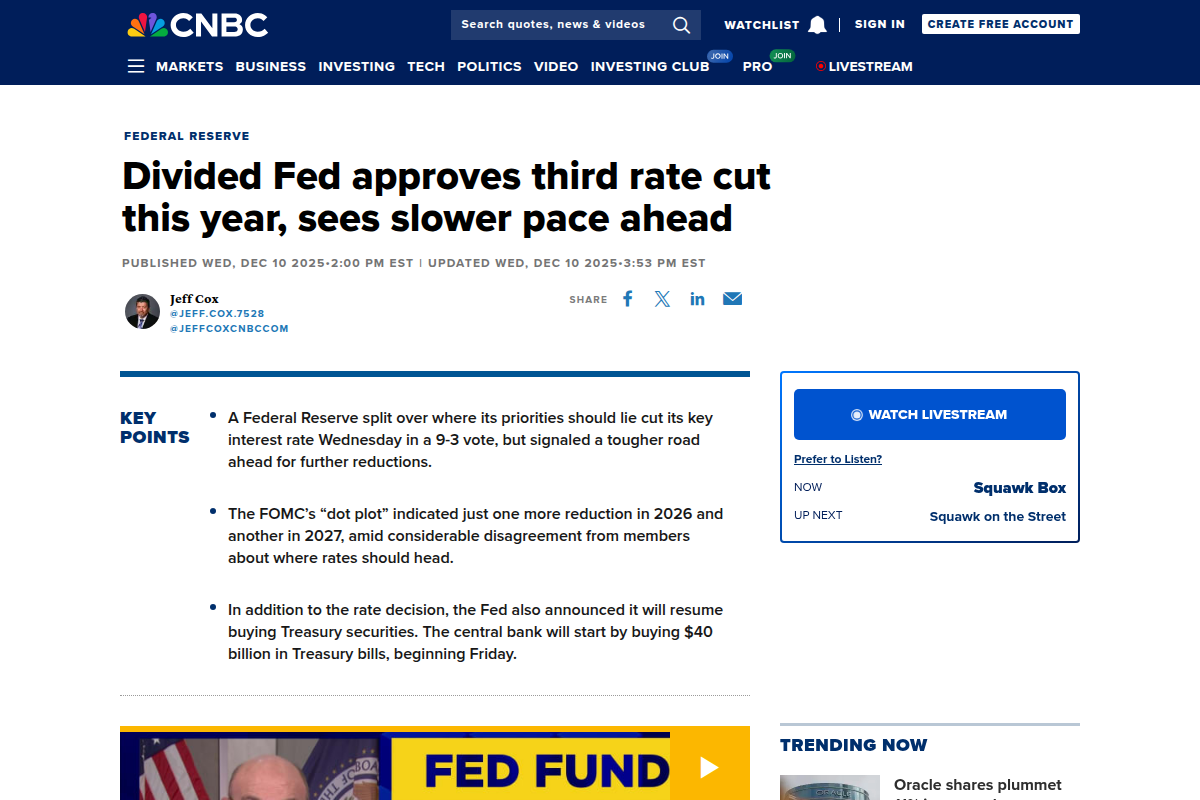
The Federal Reserve voted on Wednesday to cut its key interest rate for the third time in 2025, trimming the benchmark lending rate by a quarter point. The decision came after a tense meeting of the Federal Open Market Committee, where members split in a 9-3 vote over whether to lower rates or keep them steady. This marks the most divided vote among Fed policymakers this year. The new target for the federal funds rate is now set between 3.5 percent and 3.75 percent, its lowest point since 2022.
Fed Chair Jerome Powell spoke to reporters after the meeting. He pointed to continued weakness in the labor market and persistent inflation as factors shaping the decision. Powell noted the economy may be losing close to 20,000 jobs per month, based on revised estimates. He signaled the central bank’s growing concern about slow job growth, after months where inflation was the main focus. The Fed expects inflation pressure from White House tariffs to decrease by early 2026, which could open the door for more rate cuts if job growth keeps slowing.
The decision drew national attention and reactions from Washington. President Donald Trump, who has often criticized the Fed for not acting sooner, said the latest cut should have been “at least doubled.” At a White House roundtable, Trump said, “We should have the lowest rates in the world.” Others argued that the Fed’s choices were shaped by the administration’s economic policies. Alex Jacquez of Groundwork Collaborative said, “Trump’s reckless handling of the economy has backed the Fed into a corner,” pointing to the stress on working families as the holidays approach.
Impact on consumer borrowing and mortgages
The rate cut is expected to lower borrowing costs for many Americans, including those with credit cards, car loans, and home equity lines. Lisa Sturtevant, chief economist at Bright MLS, said this move “translate[s] into lower short-term borrowing costs” for most consumers. Still, many homebuyers hoping for relief on mortgage rates may not see much change in the near future.
Mortgage rates have dipped slightly over the past year. For the week ending December 4, the average 30-year fixed-rate mortgage was 6.19 percent, down from 6.69 percent a year ago. The drop is modest, especially given the expectation of the latest rate cut. Sturtevant warned, “Potential homebuyers waiting for lower mortgage rates are going to be disappointed. In fact, rates could actually increase in the coming weeks.” She explained that internal divisions at the Fed and concerns about inflation could push mortgage rates higher, even as the central bank lowers its policy rate.
Not all economists see immediate relief for buyers. Anthony Smith, senior economist at Realtor.com, said the Fed’s policy decision “will not be, by itself, a direct catalyst for lower mortgage rates.” Instead, he said markets are watching for more labor market weakness and clear signs that inflation will stay under control.
For many Americans, the cost to buy a home remains a challenge. Even as rates ease slightly, high home prices, property taxes, and insurance costs are keeping buyers on the sidelines. Sturtevant said, “Economic uncertainty is holding buyers and sellers back.” Home sales in 2025 are tracking below 2024 levels, even as more homes are on the market than a year ago.
Looking to 2026: Uncertainty for households and markets
The path ahead for both the Fed and the economy remains murky. Fed officials gave no clear sign on whether another rate cut would come in early 2026. Instead, the focus has shifted to upcoming data on jobs and inflation. Jeff DerGurahian, chief investment officer at loanDepot, said the Fed’s next steps would depend on whether labor market weakness continues. If so, he said, the central bank “may be set for further easing” if inflation also stays under control.
Forecasts from Bright MLS and Realtor.com suggest that mortgage rates will likely stay above 6 percent through the end of 2026. Smith expects rates to “remain broadly in line with current levels” and says that, while buyers may miss out on sharp relief, affordability could improve if incomes rise and home price growth slows.
The divided vote inside the Federal Reserve Board points to the deep uncertainty about the economy’s next moves. Some policymakers worry about acting too fast and fueling another run-up in prices. Others see risks in a job market that is already slowing. For now, markets will watch the next round of labor data and inflation reports to see if the Fed’s cautious path leads to more changes in rates in 2026.
For more on the Fed’s vote and what it means for consumers, see the CNBC report.
The next few months promise more debate, both inside and outside the Fed, as policymakers try to balance slowing growth and lingering inflation. Households and markets alike are waiting for signs of whether the country can expect more rate cuts—or if this week’s move marks the end of the current easing cycle.