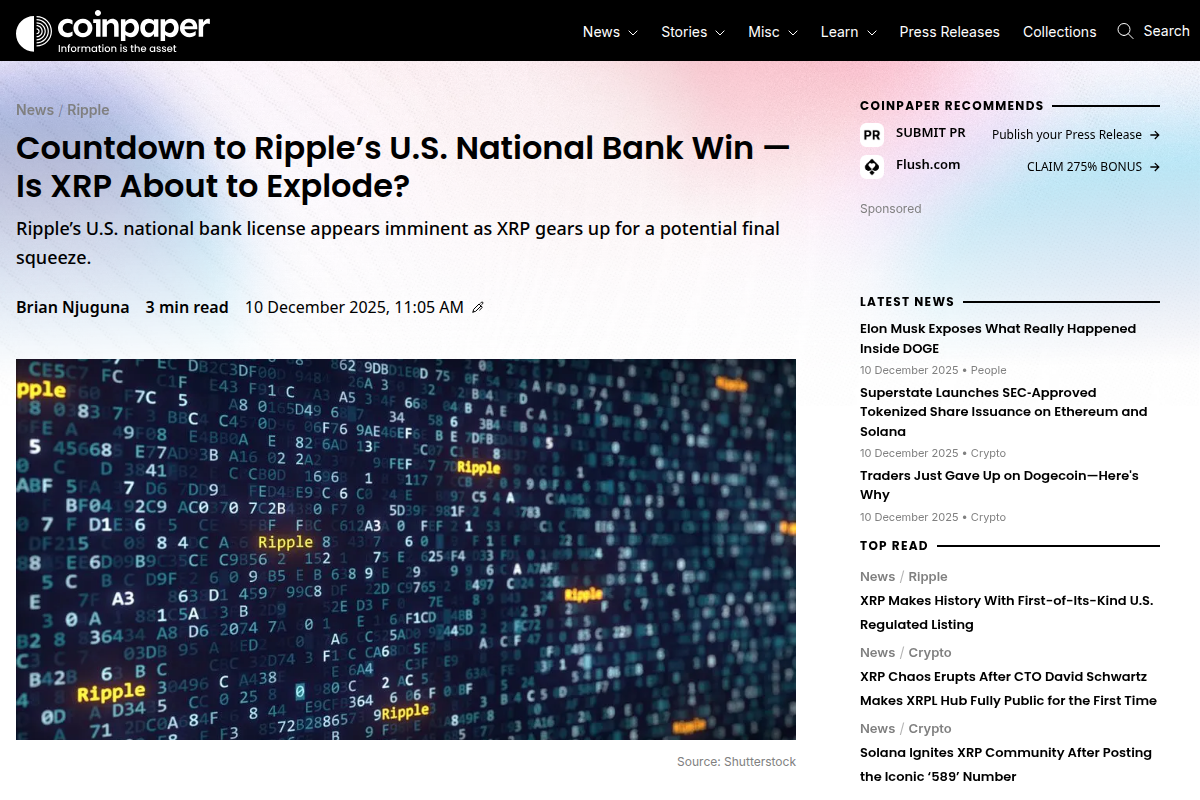
Ripple’s application for a United States national bank license has placed XRP at the center of attention among digital asset traders. Crypto analyst Steph is Crypto described the license as “imminent,” saying Ripple’s next steps could change both the company and its token, XRP, in ways that reach beyond speculation. If Ripple secures approval from the Office of the Comptroller of the Currency and gains a Federal Reserve master account, it will have the ability to operate as a federally regulated bank. This would position Ripple alongside traditional institutions for the first time.
The company applied for this charter in July 2025. If approved, Ripple could offer regulated deposit accounts, digital asset custody, and direct settlement with the Federal Reserve. Its stablecoin RLUSD would stand on equal regulatory footing with dollars held in banks. For many observers, this would be a first for a blockchain company, and it may bring the credibility needed to attract institutional clients in the United States.
The short-term action surrounding XRP has reflected this anticipation. Market expert Vlad Anderson noted that XRP recently tested its $2 support line, with strong buying activity pushing the price above $2.08. While Bitcoin, Ethereum, and Solana all saw little movement, XRP’s trading volume spiked by 77 percent, showing investor interest focused on this decision point. According to Anderson, if XRP falls below $2.02, prices may drop into the $1.85 to $1.90 range, bringing fresh volatility. Yet a stable hold above $2 could set up a run higher if traders sense a breakout in the days ahead. The recent surge and volume increase have set the stage for what Anderson called a “final squeeze” where the price may swing sharply in either direction. For many, these conditions invite both speculative trading and larger institutional involvement, should key support hold. Coinpaper reported that such a move would give Ripple and XRP a real shot at reshaping cross-border payments and liquidity.
Long-Range Prediction Out to 2027
The focus on Ripple’s compliance and regulatory standing is not just about short-term price. In a recent analysis, Nasdaq’s Alex Carchidi called XRP the top fintech coin to consider holding through 2027. He argued that Ripple and the XRP Ledger are positioned to serve financial institutions, including banks and large corporations, as the blockchain sector races to become the “plumbing” behind global payments.
Ripple’s strategy centers on working alongside banks and fintechs rather than trying to replace them. The XRP Ledger’s compliance features help these institutions meet regulatory demands with tools that let them control access and respond to suspicious activity. These features are seen as a requirement for large clients looking to use crypto for international transfers or to hold digital assets on their balance sheets.
Ripple’s introduction of RLUSD, a U.S. dollar stablecoin for cross-border payments and as trading collateral, adds to this package. RLUSD has a reported market cap of $1.2 billion, showing early traction among institutional users. The competition in the fintech coin space includes Stellar, Algorand, and Tron, but Nasdaq’s analysis said only Ripple offers the full set of compliance, payment, and tokenization features needed by large financial players. According to Carchidi, Ripple’s push to acquire companies and expand its service offerings could help XRP grow its role as a bridge asset, with the potential for long-term value growth as adoption widens (Nasdaq).
Some observers note that XRP’s price action has not always followed news flow. According to CoinDesk, XRP climbed to $2.17 recently but then fell back as large holders appeared to sell into strength, suggesting some traders are locking in gains ahead of the bank license decision.
Competition and Next Steps
Ripple’s future is not just about regulatory wins. A Ripple executive said that the company should study Solana’s recent growth to remain competitive. Solana’s rise has highlighted new ways to scale blockchain networks, and Ripple may look to borrow ideas as its XRP Ledger evolves.
The coming days look critical. XRP hovers just above support, with a surge in trading activity and the bank charter decision looming. If Ripple secures the license, it could change the company’s position in the U.S. financial system. This move could boost confidence among large institutions, drive demand for both XRP and RLUSD, and open new opportunities for cross-border payments.
If the license is delayed or denied, XRP could face more sell pressure, especially with traders watching the $2 support level closely. The path Ripple chooses — and the result of its license bid — will set the tone for XRP’s price and its role in digital finance through 2027 and beyond.
The next few days are likely to produce clear signals. XRP’s position at a technical and regulatory crossroad has drawn in traders, institutions, and analysts. As the market waits, both short-term price swings and long-term predictions depend on Ripple’s next steps and the response from U.S. regulators.